
Reported SpeechVersión en línea
por Andrea Springer
Cover/Title
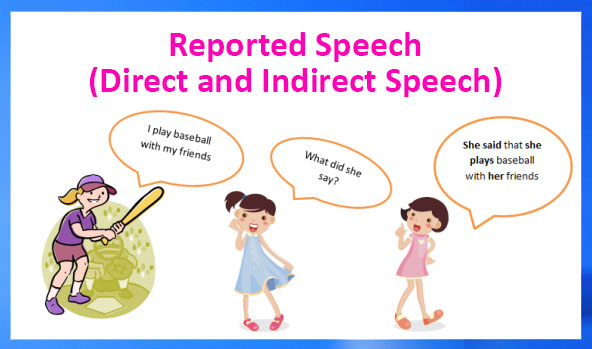
What to report
We can report:
- statements (with tell and say)
- questions (with ask)
- commands, requests, suggestions (with admit, claim, promise, explain, deny, insist, suggest)
Direct vs. Reported Speech.
Direct speech is the exact words someone said. We use quotation marks in Direct speech.
- "I'll go to London," she said.
Reported speech is the exact meaning of what soemone said but not the exact words. We do not use quotation marks in Reported speech.
- She said she would go to London.
Say and tell
say: we use it in both Direct and Reported speech, but in Reported speech we use say when it is not followed by the person the words were spoken to.
said + (what was said) - without a direct object
- Direct speech: She said to me, " I am very tired."
- Reported speech: She said she was very tired.
tell: we use tell in Reported speech when it is followed by the person the words were spoken to.
told + a person + (what was said) - when there is a direct object
- Reported speech: She told me that she was very tired.
In trouble?
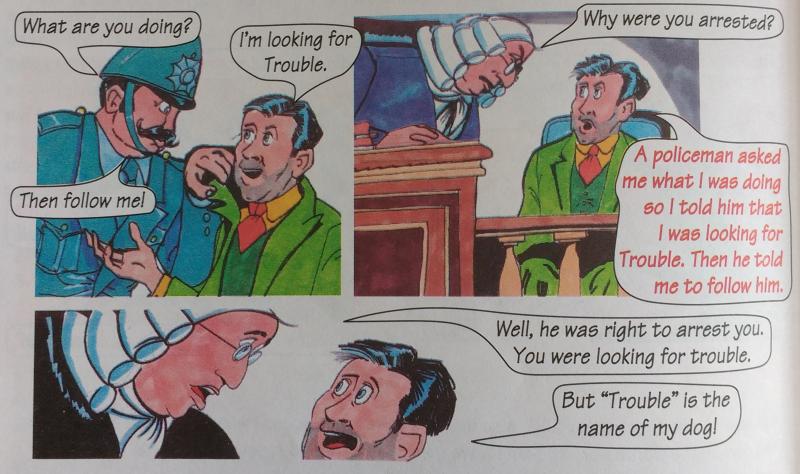
Reported statments
Reported statements
- To report statements we use an reporting verb (say, tell, advise, explain, promise, admit, claim, confirm, deny, insist, remind)
- Pronuns and possessive adjectives change acording to the meaning.
- Direct speech: He sad, "I can't fix it by myself."
- Reported speech: He said he couldn't fix it himself.
- Direct speech: "This is my book," he said.
- Reported speech: He said that was his book.
3. Certain words change as follows:
- Direct speech: this/these, here, come
- Reported speech: that/those, there, go
modal verbs
Some important facts to have in mind:
Modal verbs that change:
- can changes to could
- will changes to would
- may changes to might
Modal verbs that do not change:
would, could, might, should, ought to, mustn't
Be aware of must:
Must stays the same or changes to had to.
"You must work harder."
She told me I must work harder.
She told me I had to work harder.
tense changes
When the reporting verb is in the Past Tense the verb tenses change as follows:
- Present Simple to Past Simple
"I can't remember his name," she said.
She said she couldn't remember his name.
- Present Continous to Past Continous
"I'm saving up." He said he was saving up.
- Present Perfect to Past Perfect
"I've bought you some flowers," she said.
She said she had bought me some flowers.
- Past Simple to Past Perfect
"He lost all the money," she said.
She said that he had lost all the money
- Future (will+infinitive) to Conditional (would+infinitive)
"I'll see you later," he said.
He said he would see me later.
Hint: the verb in the reported speech usually 'goes back' one tense into the past
Exception: Past Perfect and Past Continuous stay the same: had played and was playing
exceptions
There are no changes in verb tenses when the reporting verb is in one of the following tenses:
- Present
- Future
- Present Perfect
- or when the sentence expresses general truths, permanent states and conditios
- "Water turns into ice," he said.
- He said water turns into ice. (permanent truth)
- or the speaker reports something immediateley after it was said:
- "I will call you back," he said.
- He said he will call you back. (immediate reporting)
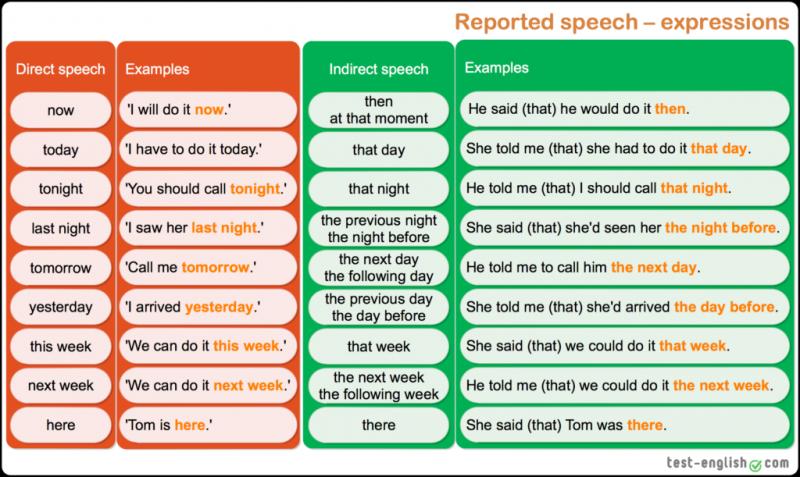
Expressions of time
GETTING IT?

Reported questions
Reported questions
For Reported questions the affirmative word order (subject + verb) is used and there is no question mark.
a) ask + wh- word + object when the direct question begins with what, why, who, where etc
He said: "What are you doing?" > He asked what I was doing.
b) ask + if/whether + object when the direct question begins with and auxiliary verb like do, have, can etc
Indirect vs. reported
We use Indirect questions to ask for information/advice.
- I wonder whether to phone her.
- Do you know what time it is?
If the Indirect question starts with I wonder ... or I doubt..., then the question mark is omitted.
We use Reported questions to report someone else's questions, suggestions, offers or requests.
- He asked me whether he should phone her.
- He asked me what time it was.
Question words like what, who, where etc or whether can be followed by an infinitive in the reported sentence.
- He asked me where to put it.
Commands, warnings, advice
- Construction in Reported commands, warnings, requests and advice: Subject+verb+object+infinitive with to
- "Shut up">He told me to shut up.
- "Don't go">She advised us not to go.
- Agree, invite, offer, promise, remind as reporting verbs: Subject+verb+(object)+infinitive with to
- "Please come with us.">They invited me to go with them.
- "I promise I'll pay."> I promised to pay.
- Add, admit, agree, claim, comment, deny, explain, insist, suggest can also be used as reporting verbs: Subject+verb+that clause
- "I love him."> She admitted that she loved him.
Good luck.